Category: Quick Art History Reads

Gwendolyn Knight Lawrence – Artist

Gwendolyn Knight Lawrence's first formal study of art came at Howard University, where she studied with the painter Lois Maillou Jones and with printmaker James Lesesne Wells. During the Harlem Renaissance, Knight became a daily participant in the workshop of sculptor Augusta Savage, director of the Savage Studio of Arts and Crafts and later of the Harlem Community Arts Center. Throughout the 1940s, 1950s, and 1960s, Knight became an itinerant artist of sorts, accompanying her husband, Jacob Lawerence, as he pursued new opportunities.

Read more Gwendolyn Knight Lawrence – Artist

Harriet Powers – Folk Artist

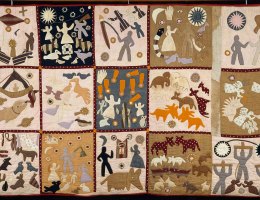
Harriet Powers used traditional techniques in her quilts to record local legends, Bible stories and astronomical events on her quilts. One of the panels on Powers quilts illustrate the “dark day” of May 19, 1780 (which is now known as dense smoke over North America caused by Canadian wildfires) and the November 13, 1833, as the “night of falling stars” that convinced many terrified Americans that Judgment Day had come, but was later identified as the Leonid meteor storm. Two of her quilts are on display at the National Museum of American History in Washington, DC; Bible Quilt of 1886 and Pictorial Quilt of 1898.[2]

Read more Harriet Powers – Folk Artist

Clementine Hunter – Folk Artist

Clementine Hunter is celebrated for her use of bold colors and shapes to narrate plantation life in 19th and 20th century Louisiana as an African American. Clementine Hunter is Louisiana’s most famous female artist, and she is one of the most important folk artists of all time.
Her work can be seen in the Smithsonian Institute, the New Orleans Museum of Art, the Museum of American Folk Art in New York, the High Museum of Atlanta, the Dallas Museum of Fine Arts, the New York Historical Association, the Oprah Winfrey Collection in Chicago and many other museums and private collections across the country.[1]

Read more Clementine Hunter – Folk Artist

Dr. Selma Burke – Sculptor

Some of Burke’s most notable sculptures include Temptation (1938),  Despair (1951),  Fallen Angel(1958), Mother and Child (1968), and Together (1975).  A nine-foot statue of Martin Luther King, Jr. she completed while in her eighties is on display in Marshall Park in Charlotte, North Carolina.  She received numerous awards and honors which included three honorary doctorate degrees.  In 1979 Burke was recognized by President Jimmy Carter for her contribution to African American art history.[4]

Read more Dr. Selma Burke – Sculptor