Artist: Harmonia Rosales
At the time I didn't know who the artist was but my first thought was....now this makes sense. It was that moment of wow! This is an art piece I would love to see up close.
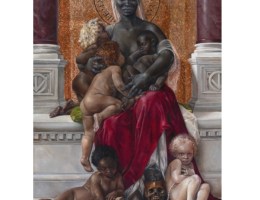

At the time I didn't know who the artist was but my first thought was....now this makes sense. It was that moment of wow! This is an art piece I would love to see up close.
In South of Pico Kellie Jones explores how the artists in Los Angeles's black communities during the 1960s and 1970s created a vibrant, productive, and engaged activist arts scene in the face of structural racism. Emphasizing the importance of African American migration, as well as L.A.'s housing and employment politics, Jones shows how the work of black Angeleno artists such as Betye Saar, Charles White, Noah Purifoy, and Senga Nengudi spoke to the dislocation of migration, L.A.'s urban renewal, and restrictions on black mobility.

Elizabeth Catlett's "Glory" inspires music. The sculptures of the late African-American artist and civil rights activist Elizabeth Catlett are the inspiration for a new jazz composition. Rufus Reid, a bass musician who's been playing jazz for half a century, uses Catlett's artwork to explore the intersection between music and the visual arts. In his new project, called "Quiet Pride," Reid tries to convey Catlett's sculptures in sound. [1]

Read more “Glory” inspires Quiet Pride: The Elizabeth Catlett Project
Elizabeth Catlett, Singing Head, 1980, black Mexican marble, Smithsonian American Art Museum, 16 x 9 1/2 x 12 in. (40.7 x 24.2 x 30.5 cm.)


 kymberligrant.com